Blog

Mechanical Engineering Principles Applied to the Human Body: Meet Structural Management®
The human body is often described in biological terms—muscles, nerves, organs, and tissues. Yet, when viewed through the lens of mechanical engineering, a deeper and more actionable truth emerges: the body is a load-bearing, force-transmitting structure governed by the same physical laws that dictate the performance of bridges, buildings, and machines. This perspective is not merely philosophical—it is practical, measurable, and profoundly important for understanding injury, performance, and long-term health.
Mechanical engineering teaches us that structure dictates function. A bridge with uneven load distribution will eventually fail at its weakest point. A machine with misaligned components will wear down prematurely. The same is true for the human body. When structural relationships—such as alignment, symmetry, and balance—are compromised, the body compensates. These compensations may allow continued function in the short term, but over time they lead to inefficiency, degeneration, and injury.
This is where Structural Management® becomes invaluable.
The Body as a Mechanical System
At its core, the human body operates as a system of levers, joints, and load-bearing segments. Bones serve as structural beams, joints as pivot points, and muscles as actuators generating force. Every movement—walking, running, throwing, even standing—requires the coordinated transfer of forces through this system.
One of the most fundamental principles in mechanical engineering is load distribution. When forces are evenly distributed across a structure, it functions efficiently and with minimal wear. However, when loads become uneven, stress concentrations develop. In engineered systems, these stress concentrations are where cracks form and failures begin. In the human body, they manifest as pain, inflammation, and injury.
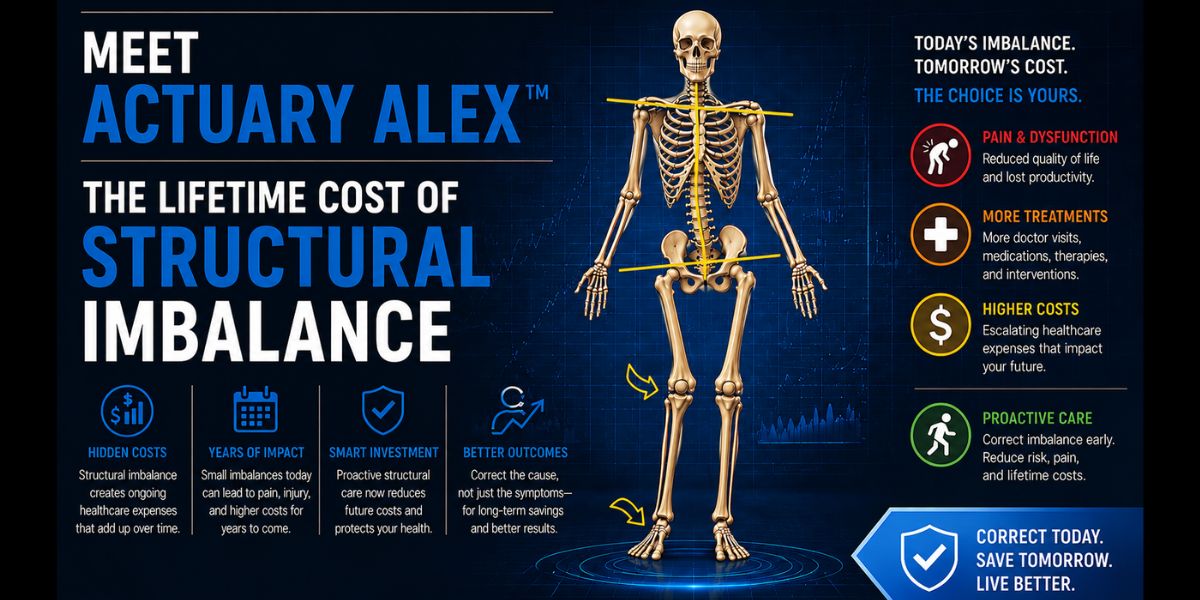
For example, a subtle asymmetry in pelvic alignment or a collapse in the foot’s arch can shift load disproportionately to one side of the body. Over time, this imbalance may contribute to knee pain, hip dysfunction, or spinal degeneration. The body adapts—because it must—but adaptation is not the same as optimization.
Compensation: The Body’s Engineering Workaround
In engineering, systems are often designed with redundancy to ensure continued function even when a component fails. The human body exhibits a similar capability through compensation patterns. If one joint loses mobility or stability, another region will compensate to maintain movement.
While this is a remarkable survival mechanism, it comes at a cost. Compensation redistributes forces in ways the body was not designed to handle. Over time, these altered force pathways increase mechanical stress on tissues, accelerating wear and tear. This is why symptoms often appear far from the true source of dysfunction.
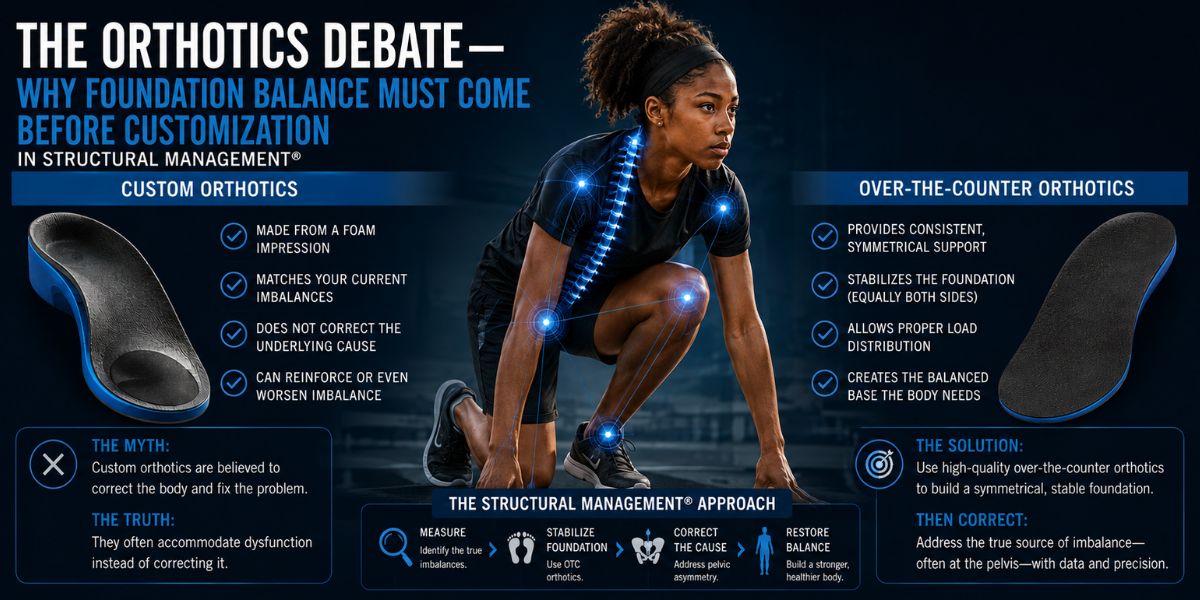
Structural Management® recognizes and addresses these compensation patterns by identifying the root mechanical imbalance rather than merely treating the symptoms. It applies an engineering mindset: analyze the system, locate the deviation, and restore proper alignment.
Fatigue Failure and Repetitive Stress
Another key concept in mechanical engineering is fatigue failure—the idea that repeated, submaximal stress can cause a material to fail over time. Importantly, the load does not need to be excessive; it simply needs to be applied repeatedly.
In the human body, this principle explains the prevalence of overuse injuries. Tendonitis, stress fractures, and disc degeneration are not typically the result of a single traumatic event, but rather the accumulation of small stresses applied over thousands of cycles. When the body’s structure is misaligned, these stresses are amplified in specific areas, accelerating the fatigue process.
Structural Management® reduces the risk of fatigue failure by ensuring that forces are distributed as evenly as possible. By correcting underlying asymmetries, it minimizes the repetitive overload that leads to chronic injury.
Center of Gravity and Stability
Mechanical systems rely on a stable relationship between the center of gravity and the base of support. When this relationship is optimal, the system is balanced and efficient. When it is not, instability and increased energy expenditure result.
In humans, structural imbalances can shift the center of gravity, forcing the body to expend more energy to maintain balance. This not only reduces performance but also increases the likelihood of falls, strains, and other injuries. Structural Management seeks to restore this balance, improving both stability and efficiency.
The Foundation: Why the Feet Matter
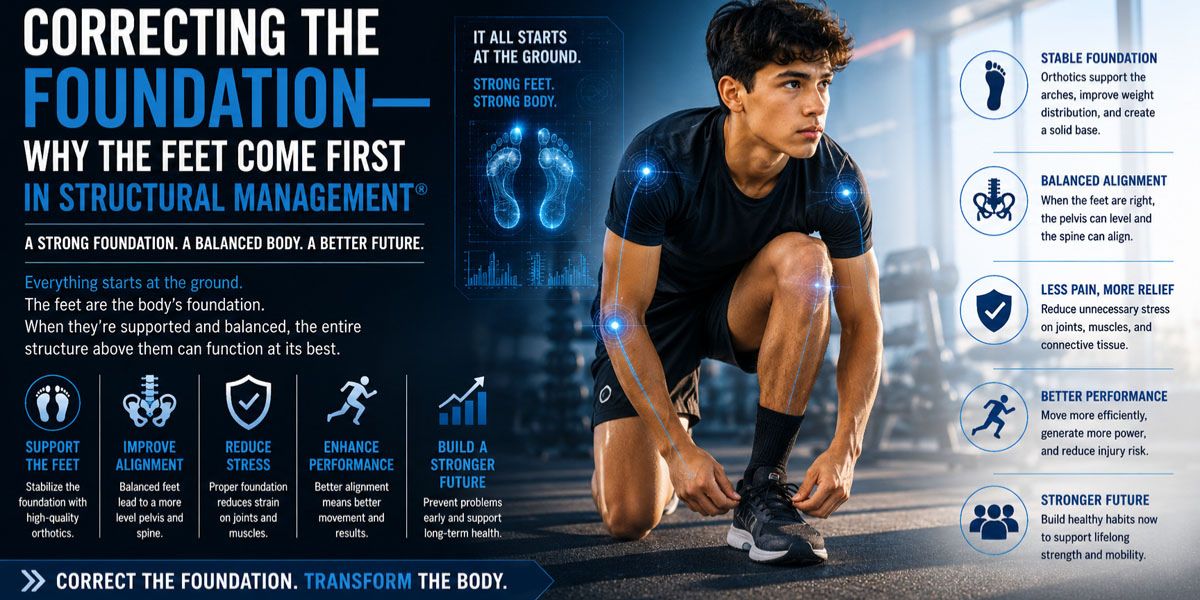
In any structure, the foundation is critical. A building constructed on an unstable base will develop cracks and distortions throughout its frame. Similarly, the human body relies on the feet as its primary foundation.
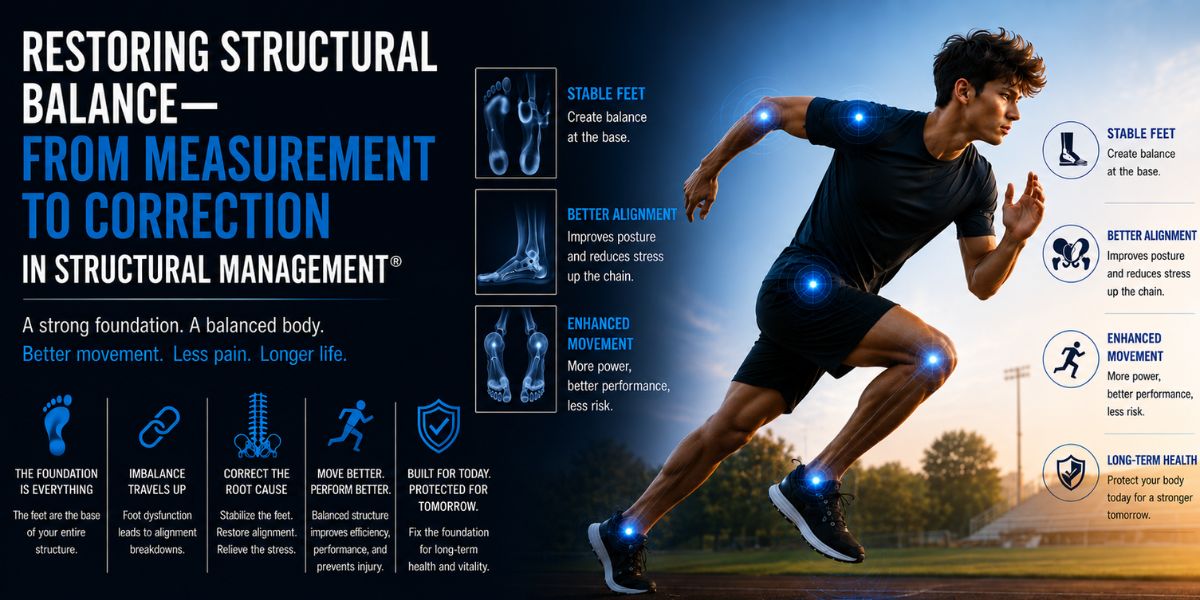
When the feet collapse or function asymmetrically, they alter the alignment of the entire kinetic chain—from the ankles and knees to the hips and spine. This is why addressing the foundation is a cornerstone of Structural Management®. By stabilizing and correcting the base, the entire system can function more effectively.
Structural Management: An Engineering Approach to Health
Structural Management® represents a shift from symptom-based care to system-based care. It emphasizes measurement, analysis, and correction—principles that are central to engineering disciplines. Rather than asking, “Where does it hurt?” it asks, “Where is the structure compromised?”
This approach offers tremendous value:
- Injury Prevention: By correcting imbalances before they lead to symptoms, Structural Management reduces the risk of injury.
- Performance Enhancement: Efficient force transmission improves strength, speed, and endurance.
- Longevity: Proper load distribution minimizes wear and tear, preserving joint and tissue health over time.
- Clarity in Care: Objective measurements replace guesswork, leading to more precise and effective interventions.
A New Paradigm
The integration of mechanical engineering principles into human health represents a powerful paradigm shift. It moves us away from reactive care and toward proactive optimization. It acknowledges that the body, like any engineered system, performs best when its structure is sound.
Structural Management® embodies this philosophy. It recognizes that alignment is not a cosmetic concern but a mechanical necessity. It understands that small deviations, when repeated over time, can lead to significant consequences. And it provides a framework for correcting these deviations in a systematic and measurable way.
In a world where musculoskeletal problems are increasingly common, this approach offers a clear path forward. By treating the human body as the sophisticated mechanical system it is, Structural Management® unlocks the potential for better health, improved performance, and a higher quality of life.
All Blog Articles