Blog

The Orthotic Myth — Why the Industry Got It Wrong
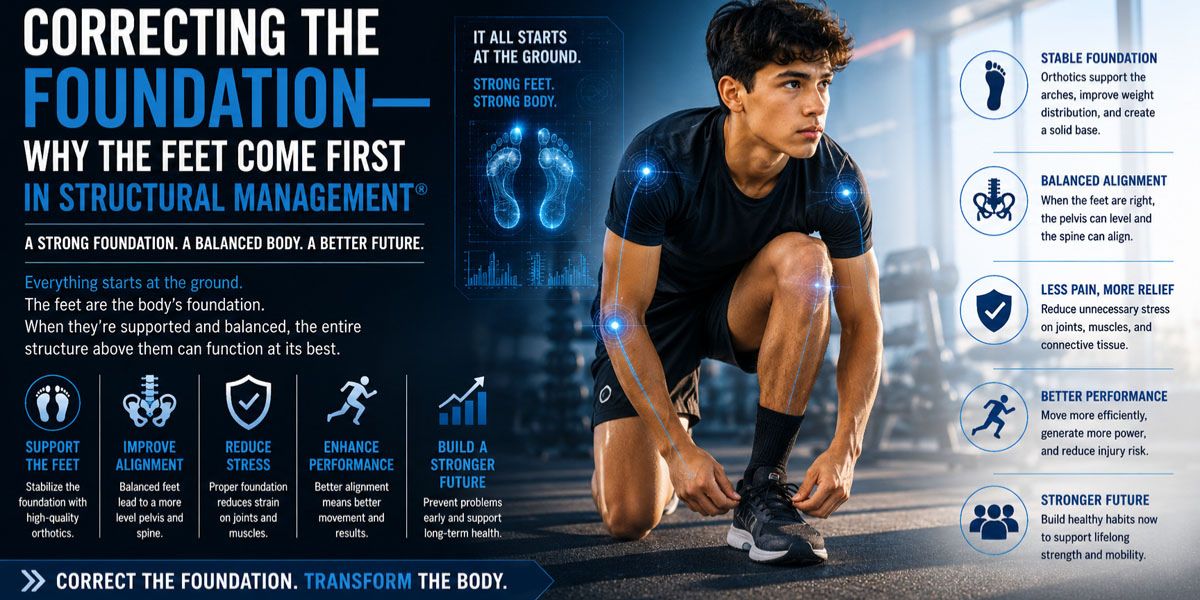
There is a belief so widely accepted in healthcare that it is rarely questioned: if you correct the feet, you correct the body. This idea has been repeated for decades—in clinics, in textbooks, and most aggressively in marketing. Orthotics are often presented not just as supportive devices, but as structural solutions. Patients are led to believe that by placing orthotics in their shoes, their pelvis will level, their posture will improve, and their biomechanical problems will begin to resolve. It is a clean, simple narrative. And it is dangerously incomplete.
At the core of this belief is an assumption that has gone largely unchallenged—that the human body is fundamentally symmetrical. It is not. In reality, asymmetry is the rule, not the exception. Every individual presents with some degree of imbalance, and the real question is not whether imbalance exists, but how much, where it is located, and what consequences it creates over time. This is especially important in athletes, where small imbalances are magnified through repetition, load, and performance demands.
This realization did not come from theory. It came from data. Over a three-year period, I conducted a study involving 351 patients, ranging in age from 10 to 79, with the goal of observing what actually happens to the body when orthotics are introduced. Each patient underwent a precise and repeatable process, including a high tech evaluation of the feet, a standing A-P lumbo-sacral x-ray while barefoot, and a second x-ray taken after custom orthotics were placed in their shoes. This allowed for direct measurement of femoral head height difference (FHHD), a clear and objective indicator of pelvic imbalance.
If the prevailing belief were true, the results should have been straightforward. Orthotics would go in, the pelvis would level, and imbalance would consistently improve. But that is not what the data showed. While 42% of patients demonstrated a reduction in femoral head height difference, a significant 36% showed no change at all, and perhaps most striking, 22% actually became more imbalanced after wearing orthotics. In other words, nearly one out of every four patients experienced a worsening of the very imbalance orthotics are often expected to correct.
Even more revealing was the broader finding that femoral head height differences remained largely unaffected overall by orthotic intervention. This directly challenges the foundational assumption that correcting the feet automatically corrects the pelvis. Orthotics can absolutely play an important role—they support collapsing arches, improve foot mechanics, and help distribute load more evenly at the ground level. However, the human body is not a simple stack of segments where fixing the foundation guarantees alignment above. It is a dynamic, adaptive system that compensates over time.
When imbalance exists higher in the chain—at the pelvis, spine, or through long-standing compensation patterns—introducing orthotics does not erase those adaptations. In some cases, it may expose them. In others, it may shift forces in a way that increases imbalance elsewhere. This is why the outcomes in the study were not uniform. Some patients improved, some stayed the same, and some became worse. The orthotic did not fail. The model failed.
The deeper issue is not the use of orthotics, but the reliance on assumption without measurement. In most cases, orthotics are prescribed without ever verifying what they do to the pelvis. There is no before-and-after imaging, no quantification of structural change, and no objective confirmation that the intended correction has occurred. This creates a gap between what practitioners believe is happening and what is actually happening inside the body.
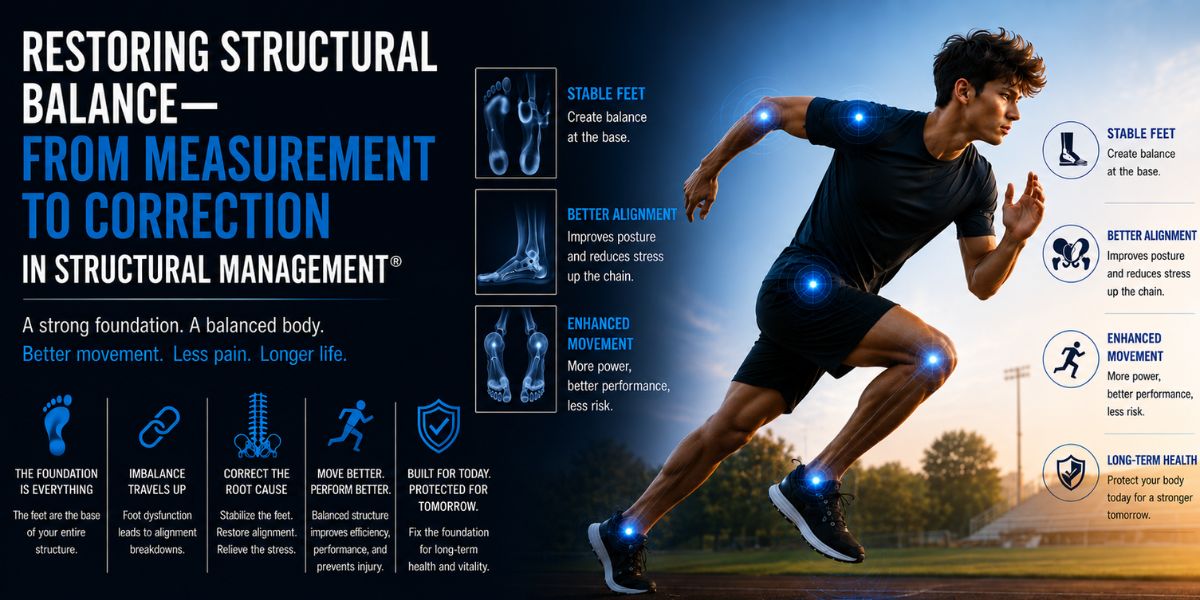
It was this gap that led to the development of the Structural Fingerprint system. If every individual presents with unique and measurable imbalances, and if those imbalances do not automatically correct with standard interventions, then the only responsible approach is to measure, classify, and correct based on objective data. The Structural Fingerprint system is built on this principle. It recognizes that every athlete has a unique structural profile, that every imbalance must be identified rather than assumed, and that every intervention—including orthotics—must be verified.
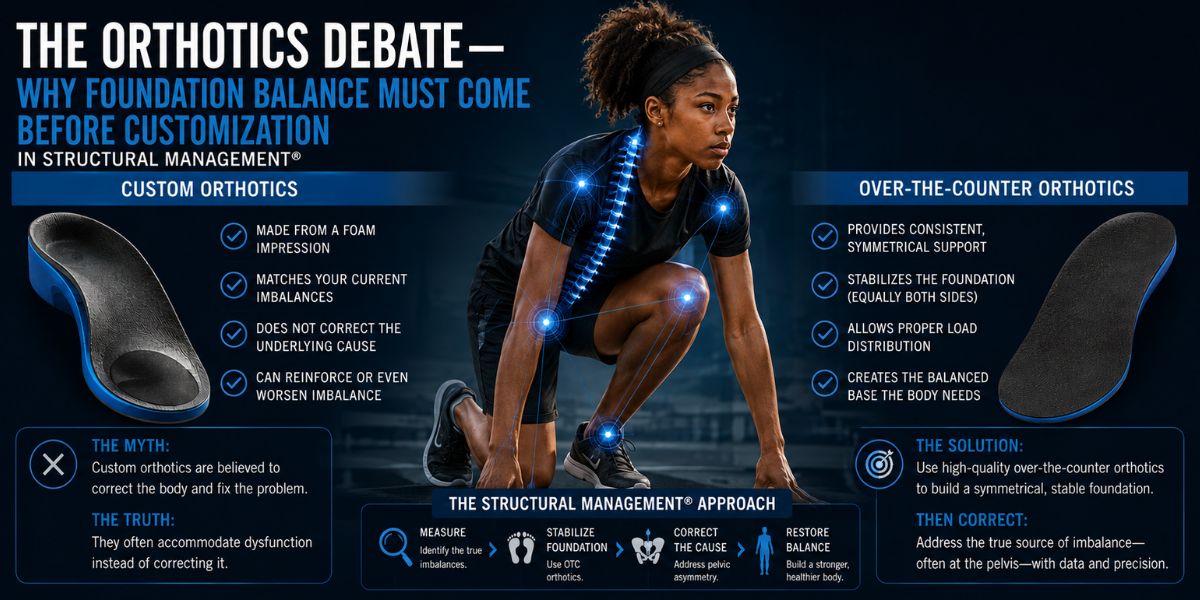
In this model, orthotics are not the solution. They are one component of a larger, integrated strategy. Sometimes they help. Sometimes they do not. And sometimes they require additional correction, such as targeted lifts or other structural interventions, to achieve true balance at the pelvic level. Without measurement, there is no way to know which is which.
This leads to a provocative but necessary truth. If orthotics automatically leveled the pelvis, there would be no need to measure femoral head height. If the body were naturally symmetrical, widespread imbalance would not exist. And if current models were sufficient, we would not be facing a growing epidemic of musculoskeletal injuries, particularly in young athletes.
The question is no longer whether orthotics have value. The question is whether we are willing to move beyond assumption and begin measuring what actually matters. Because when it comes to the long-term health, performance, and durability of the human body, especially in developing athletes, guessing is no longer acceptable.
All Blog Articles