Blog

The Importance of Imaging for Structural Management®
In engineering, no critical structure is evaluated blindly. Bridges are stress-tested, aircraft components are scanned for microscopic fatigue, and buildings are analyzed internally before major structural decisions are made. Engineers understand a simple but essential truth:
You cannot accurately correct what you cannot objectively see.
The same principle applies to the human body.
Within Structural Management®, imaging is not viewed as optional or secondary. It is a foundational component of understanding how the body is mechanically organized under load. While observation, palpation, movement testing, and symptom history all provide valuable information, they cannot fully reveal the internal structural relationships that determine how forces move through the body. Many of the most important biomechanical imbalances are hidden beneath the surface and can only be identified accurately through proper imaging.
This is why the Structural Fingerprint® Exam relies heavily on standing, weight-bearing X-rays. Unlike non-weight-bearing studies performed while lying down, standing imaging evaluates the body under the same gravitational forces it experiences during everyday life. Since the body functions in an upright, load-bearing environment, it must be measured under those same conditions if meaningful structural analysis is to occur.
The importance of this distinction cannot be overstated. Many structural imbalances either become minimized or completely disappear when the body is unloaded. A patient may appear relatively symmetrical while lying down, yet demonstrate significant asymmetry once standing and weight-bearing forces are introduced. Structural Management® is concerned with how the body functions in the real world—not in an unloaded state disconnected from gravity.
The four primary standing X-ray views commonly utilized within the Structural Fingerprint® Exam are:
- AP Open Mouth
- Lateral Cervical
- AP Lumbar Spine/Pelvis
- Lateral Lumbar Spine
Together, these images provide a remarkable amount of biomechanical information. They reveal femoral head height differences, obturator symmetry or asymmetry, spinal alignment patterns, Ferguson’s center of gravity, sacral base angle, cervical and lumbar curve integrity, disc spacing, and overall structural balance. Just as importantly, they may identify underlying abnormalities such as spondylolisthesis, transitional vertebrae, lumbarization, sacralization, degenerative changes, or other structural variations that influence biomechanics and treatment decisions.
One of the most important measurements obtained through imaging is femoral head height difference (FHHD). Within Structural Management®, this measurement plays a central role because it reflects asymmetrical load distribution through the pelvis and lower body. Even small imbalances can alter force transmission through the spine and lower extremities, increasing stress on tissues throughout the kinetic chain. Without imaging, these asymmetries are often estimated indirectly or missed entirely.
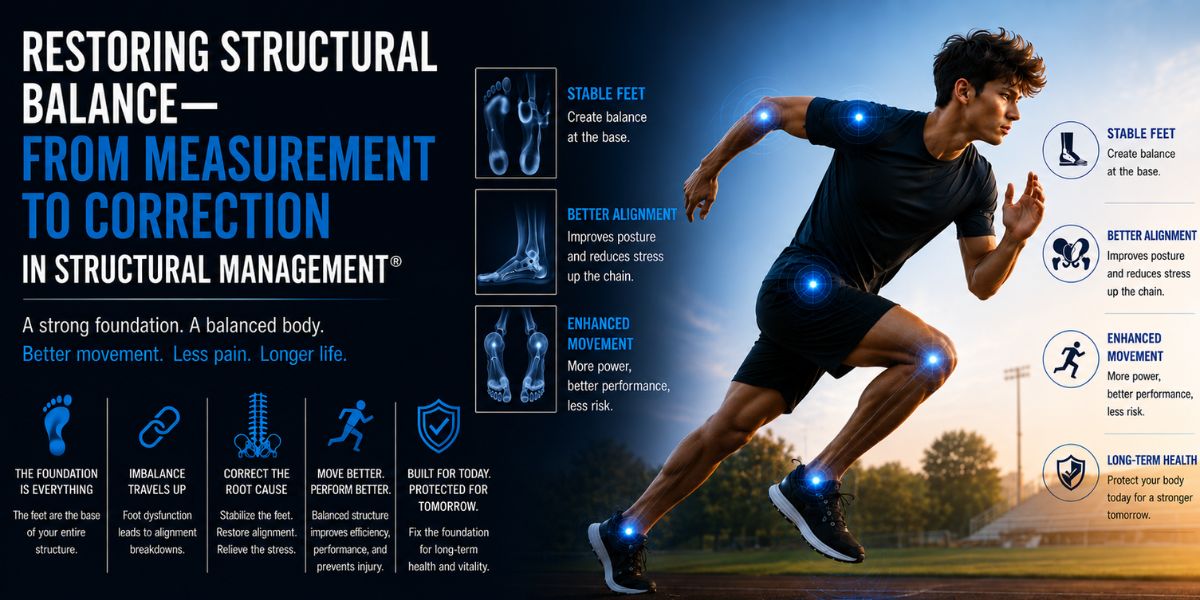
This becomes especially important after orthotic intervention. A common assumption within musculoskeletal care is that placing orthotics into the shoes automatically levels the pelvis and corrects imbalance. However, research conducted through the Structural Management® model demonstrated that approximately 70% of individuals still exhibit measurable femoral head height differences after orthotic placement. In some cases, the imbalance may even worsen. Without follow-up imaging, practitioners may incorrectly assume the correction has been successful while asymmetrical loading continues.
Imaging eliminates this guesswork.
By performing post-orthotic standing X-rays, practitioners can objectively determine whether the system has been balanced or whether additional correction—such as a heel lift—is necessary. This level of precision transforms care from assumption-based to measurement-based, aligning musculoskeletal healthcare more closely with engineering principles.
Another major advantage of imaging is its ability to establish an objective baseline. Structural patterns often develop gradually over years and may continue changing over time. By documenting alignment, disc integrity, and load relationships at the beginning of care, practitioners gain a reference point that allows for meaningful follow-up comparison. This creates accountability and provides a way to track whether structural interventions are producing measurable changes.
This is particularly valuable in youth athletes. During periods of growth and development, the body undergoes rapid structural adaptation. Identifying asymmetries early may help prevent the development of more severe compensation patterns later in life. Imaging allows practitioners to identify biomechanical stress before symptoms or degeneration become advanced, shifting care toward a more preventive model.
Critics of imaging in musculoskeletal care sometimes argue that imaging findings do not always correlate perfectly with symptoms. Within Structural Management®, this is not viewed as a weakness of imaging, but rather confirmation that pain alone is an incomplete measure of dysfunction. Structural imbalance can exist long before symptoms appear. In fact, waiting until pain develops may mean the body has already been compensating unsuccessfully for years.
The purpose of imaging, therefore, is not simply to “find pain.” It is to evaluate how the structure is organized mechanically and whether that organization is likely to create excessive stress over time.
Imaging also plays an important role in patient understanding and compliance. When individuals can visualize their own structural imbalances—pelvic asymmetry, altered spinal curves, uneven loading relationships—they often develop a much clearer understanding of why treatment is necessary. This transforms care from something abstract into something objective and measurable. Patients are no longer simply being told they are imbalanced; they can see it for themselves.
Importantly, Structural Management® does not advocate imaging without purpose or clinical reasoning. Imaging should always serve a meaningful biomechanical and clinical objective. The goal is not unnecessary exposure, but necessary information. In engineering, accurate measurement always precedes structural correction. Structural Management® applies the same principle to the human body.
As technology continues to evolve, future imaging methods may become even more sophisticated, integrating advanced motion analysis, pressure mapping, and AI-driven biomechanical modeling. However, the foundational principle will remain unchanged:
Objective structural correction requires objective structural measurement.
Ultimately, imaging is one of the defining elements that separates Structural Management® from symptom-based approaches. It allows practitioners to move beyond assumption, beyond temporary relief, and beyond generalized treatment. It provides the ability to identify hidden imbalance, measure load distribution accurately, and verify whether correction has actually occurred.
Because when dealing with a complex load-bearing system like the human body, seeing the structure clearly is not a luxury.
It is a necessity.
All Blog Articles