Blog
The Orthotics Debate—Why Foundation Balance Must Come Before Customization in Structural Management®

Few topics in musculoskeletal care generate as much debate as orthotics. Many companies and practitioners strongly advocate for custom orthotics, often claiming they are superior, more precise, and even suggesting that over-the-counter orthotics may be inadequate or potentially harmful. On the surface, this argument appears logical: if every foot is unique, shouldn’t support be customized to match that uniqueness? However, when viewed through the lens of mechanical engineering and full-body structural balance, this reasoning reveals a critical flaw.
The key misunderstanding lies in how we interpret asymmetry in the feet. When one foot appears more collapsed than the other during scanning or examination, the common assumption is that the foot itself is the problem and therefore requires individualized correction—more support on one side, less on the other, or the addition of wedges and modifications. But within Structural Management®, the feet are not viewed as the source of the problem—they are the victims of the problem. The asymmetry seen at the feet is often a reflection of uneven load distribution coming from higher up in the system, particularly at the level of the pelvis and femoral head height.
From a mechanical engineering standpoint, this distinction is critical. In any load-bearing system, when the foundation appears uneven, the first question is not “How do we customize the base to match the imbalance?” but rather “Why is the load uneven in the first place?” If a structure is experiencing asymmetrical loading, simply altering the foundation to accommodate that imbalance does not correct the problem—it reinforces it. Over time, this can perpetuate or even worsen the underlying dysfunction.
This is where the principle of foundation balance becomes essential. In engineering, a stable system requires a base that is level, symmetrical, and evenly supported. Applying this principle to the human body means that the feet—the foundation—should be supported in a way that promotes equal and balanced load distribution, not one that accommodates asymmetry. If two orthotics are designed differently to match two different-looking feet, the system is being built on an already imbalanced foundation. This approach contradicts one of the most fundamental rules of structural integrity: the base must be balanced before the system above it can function optimally.
A useful analogy can be found in automotive engineering. If a car has uneven tire wear due to poor front-end alignment, the solution is not to install custom tires with different shapes or thicknesses to match the wear pattern. Doing so would only mask the problem while allowing the underlying misalignment to persist. Instead, the correct approach is to fix the alignment first, ensuring that load is distributed evenly across both sides. Once the alignment is corrected, standard, uniform tires function as intended, providing stability and longevity.
The human body operates under the same principles. In cases where one foot appears more collapsed than the other, the underlying issue is often an imbalance in weight distribution caused by structural asymmetry—most commonly a difference in femoral head height at the pelvis. This imbalance shifts load disproportionately to one side, causing that foot to collapse more over time. The foot is adapting to the load it is given; it is not independently creating the problem.
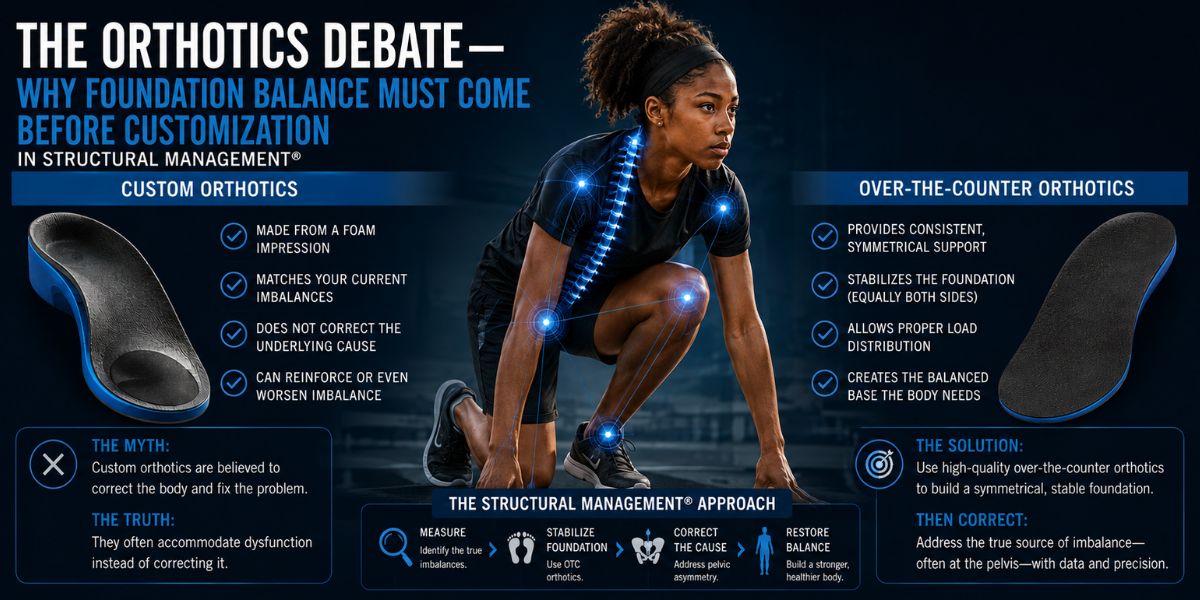
Therefore, the priority in Structural Management® is not to customize the orthotic to match the asymmetry, but to restore balance to the system. High-quality over-the-counter orthotics play a crucial role in this process because they provide consistent, symmetrical support to both feet, creating a stable and balanced foundation. By supporting both sides equally, they allow the body to begin redistributing load more evenly, which is a necessary step before higher-level corrections can be fully effective.
Once the foundation is stabilized, the next step is to address the true source of the imbalance—often at the level of the pelvis. If a femoral head height difference remains after orthotic support is introduced, it can then be corrected through appropriate interventions, such as a heel lift on the affected side. This approach aligns with engineering principles: first create a stable base, then correct the alignment of the structure above it. Attempting to solve the problem at the level of the foot alone, without addressing pelvic imbalance, is incomplete and often ineffective in the long term.
It is important to clarify that the argument is not about the inherent quality of custom versus over-the-counter orthotics in isolation. High-quality materials and proper design matter in both categories. The distinction lies in how they are used within a system of care. Custom orthotics that are designed to match asymmetry without addressing the underlying cause may reinforce imbalance. In contrast, well-designed over-the-counter orthotics used within a Structural Management® framework serve as a tool to promote symmetry, stability, and proper load distribution.
This perspective challenges a deeply ingrained belief in musculoskeletal care—that customization is always superior. In reality, customization without proper system-level understanding can lead to misguided solutions. True precision does not come from matching the current state of dysfunction; it comes from restoring the system to its optimal state.
Ultimately, the goal of Structural Management® is not to accommodate imbalance, but to eliminate it. By viewing the feet as the foundation and understanding their role within the larger mechanical system, it becomes clear that they must be supported in a way that promotes balance, not asymmetry. High-quality over-the-counter orthotics provide that balanced foundation, allowing for more accurate correction of the structures above.
In this way, the orthotics debate is reframed. It is no longer a question of custom versus over-the-counter, but rather a question of engineering principles versus symptom-based customization. When the body is approached as a mechanical system, the answer becomes clear: establish a level foundation, correct the alignment, and allow the system to function as it was designed.
Because in both engineering and human biomechanics, balance at the base determines everything above it.
All Blog Articles